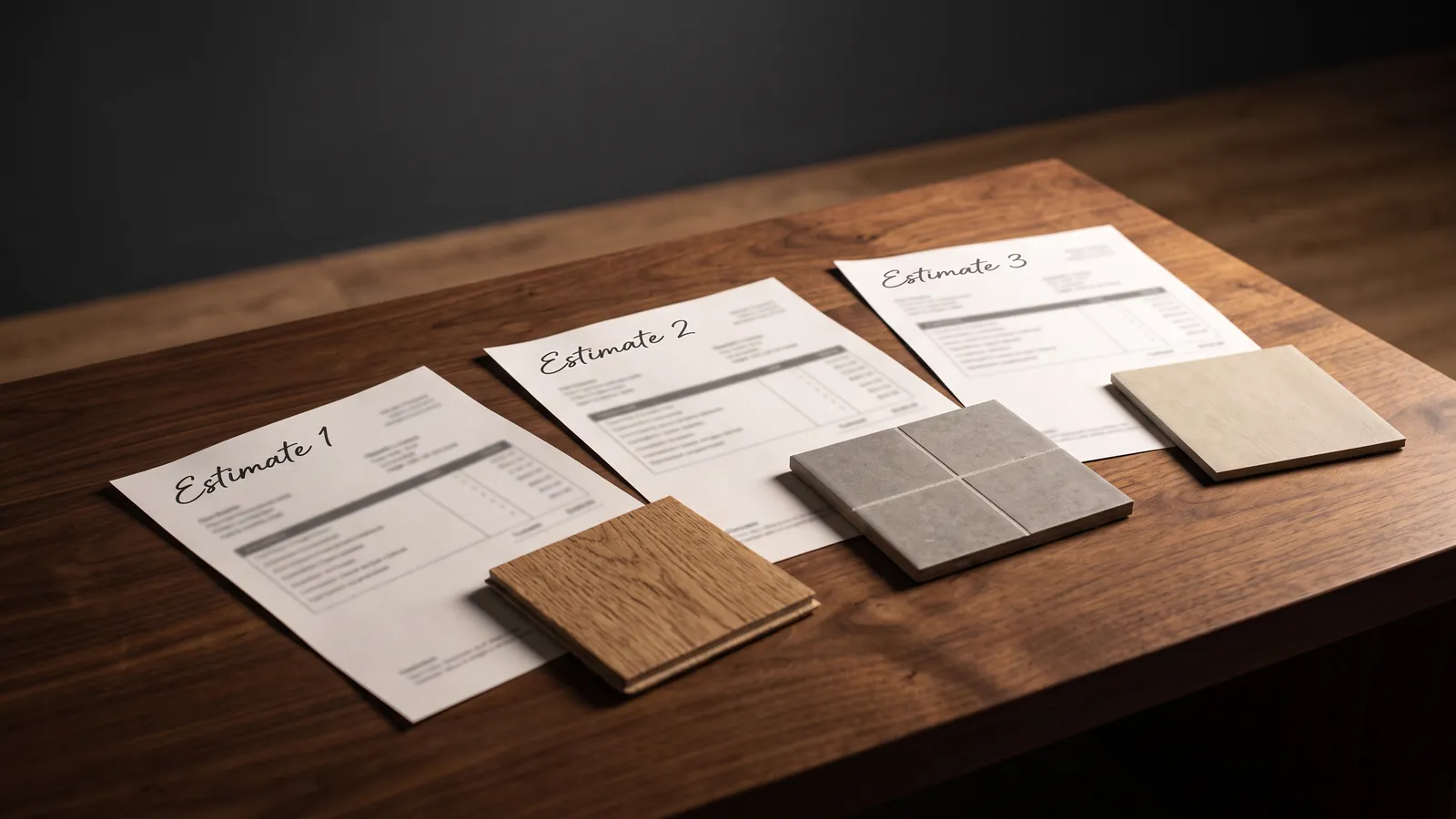
Three quotes arrive within a week of each other. One is noticeably cheaper, one is in the middle, and one is high enough to feel like a mistake. The instinct is to call the cheapest contractor and get on with it. The better move is to spend an hour turning the three documents into something comparable.
A flooring quote is a scope document with a price attached. If the scopes differ, the prices are not comparable — and they almost always differ.
Step 1: Normalize the scope
Before you compare anything, make sure all three quotes describe the same job. Check the room list, the square footage, the material, the installation method and the trim plan.
If one quote excludes a closet, includes a different underlayment, or prices a floating installation while another prices glue-down, the totals are measuring different projects. Write the differences down at the top of your comparison sheet. Sometimes the fix is a quick email asking a contractor to re-quote the same scope.
Step 2: Build one comparison sheet
Use a spreadsheet with a row for every scope item and a column for each contractor. The exact rows depend on your job, but these are the ones that matter most:
- Material, including product name and SKU
- Material overage percentage
- Labor, by room or square footage
- Old floor removal
- Debris disposal and dumpster
- Subfloor inspection and preparation
- Moisture testing and mitigation
- Baseboard removal and reinstallation
- Shoe molding or quarter round
- Transitions and thresholds
- Stair work, priced per step
- Door undercutting
- Appliance and furniture moving
- Permits, if required
- Cleanup and protection
- Warranty terms
If a quote does not mention a row, do not leave the cell blank. Write “not mentioned” — it is different from “not included,” and both are different from “included.”
Step 3: Mark every cell
Use four labels consistently:
Included means the item is in the scope and the price. Allowance means a budget figure is included and the final cost depends on what is chosen or found. Excluded means the contractor has deliberately left it out. Not mentioned means the quote is silent.
The distinction between excluded and not mentioned is where most disputes start. An excluded item is a known gap you can price. A silent item is an unknown that may become a change order.
Step 4: Price the gaps
For every cell marked excluded or not mentioned, add a reasonable estimate to that contractor’s total. You do not need a precise number; you need a consistent one across all three columns.
Use the same assumed rate for the same item in every column, so the comparison stays fair. If one contractor charges a documented rate for extra prep, use that rate for the others as well. The goal is to see which bid is lowest once the missing work is included, not to predict the final invoice exactly.
Step 5: Compare three numbers, not one
For each contractor, calculate:
- The quoted total.
- The total with all missing items added at your assumed rates.
- The total if the subfloor needs moderate additional preparation.
The third number matters because subfloor condition is the most common source of change orders. A bid that is low on paper and silent on preparation is the bid most likely to move.
Step 6: Compare the risk, not just the price
Two contractors can land on the same adjusted total with very different risk profiles. One has itemized preparation and a fixed rate for extra work; the other has a lump sum and a clause that allows billing at their discretion.
Ask yourself which contract you would rather be holding if the floor turns out to be uneven, the material arrives damaged, or the job runs a week long. The answer is usually the one with more detail, even when the total is slightly higher.
A worked example, without the dollars
Suppose the three quotes look like this:
| Scope item | Contractor A | Contractor B | Contractor C |
|---|---|---|---|
| Material | Included | Included | Allowance |
| Removal and disposal | Included | Not mentioned | Included |
| Subfloor preparation | Allowance | Not mentioned | Included |
| Moisture testing | Included | Not mentioned | Included |
| Trim and transitions | Included | Included | Excluded |
| Stairs | Not mentioned | Included | Included |
| Warranty | Workmanship, written | Manufacturer only | Workmanship, written |
On the headline totals, B may look cheapest. Once removal, preparation and moisture testing are added at a consistent rate, B’s adjusted total often moves above A. C may look expensive until you notice that the material is an allowance — the final price depends on what you choose — and that trim is excluded.
None of these quotes is necessarily dishonest. They are describing different levels of completeness, which is exactly why the headline number cannot be the deciding factor.
The traps in a line-by-line comparison
The identical total. When two contractors quote almost exactly the same number, check whether one of them copied the other’s scope without checking the site. Identical numbers with different line items are a sign that at least one quote was not built from a measurement.
The free upgrade. An unpriced extra — “we’ll include the shoe molding” — is fine if it appears in the scope. If it only exists in conversation, it does not exist in the contract.
The disappearing line. A line that appears in the quote but not in the contract is a line you may end up paying for twice. Compare the two documents side by side before signing.
The pressure to match. If a contractor offers to match a competitor’s price after seeing the other quote, ask what they will remove to get there. A price that moves without a scope change is a price that was padded to begin with.
When one quote is much higher
The highest bid is not automatically the best one, and it is not automatically padding. Before you dismiss it, ask what the difference buys.
Common reasons a quote comes in higher: it includes subfloor preparation the others excluded, it specifies a thicker wear layer or a better underlayment, it prices stair work that others left out, it includes a supervisor on site, or it builds in a longer workmanship warranty. Some of those differences are worth paying for; some are not.
Send the high bidder a short email: “Your quote is higher than the others. Can you tell me which scope items account for the difference?” A contractor who can answer line by line is usually pricing work, not guessing. A contractor who cannot explain the gap is either padding the number or unclear about their own scope, and both are reasons to keep comparing.
The same question works in reverse. If a bid is much lower, ask what was excluded rather than assuming you found a bargain.
What to send back
Once the sheet is built, send the same three questions to every contractor:
- Please confirm whether the items marked “not mentioned” are included or excluded.
- Please confirm the rate for additional subfloor preparation and who approves it.
- Please confirm the warranty terms and whether they are attached to the contract.
The replies will tell you who is organized and who is improvising. They will also give you a written record to attach to the contract.
When the cheapest quote is the right one
Sometimes it is. A small, straightforward job with a sound subfloor and a simple material can genuinely be cheaper, and a careful contractor with low overhead may beat a larger company without cutting anything.
The way to know is the same as always: the scope is complete, the preparation is described, the payment schedule is sensible, and the contract says what happens if something goes wrong. Price is the last thing you compare, not the first.
The quote guide explains each line item in more detail, and the questions page gives you the wording for the follow-up email.